Table of Contents
- What causes hair loss and thinning hair?
- What are the signs of thinning hair and how much hair loss is considered unhealthy?
- What are the conditions of each type of thinning hair?
- No matter how severe your hair loss is, it could be restored. Restoring hair loss, thinning hair to be thick again without a hair transplantation.
- Don't wait any longer! Schedule your free consultation with our experts today!
As you may know, hair loss treatment promptly is better. It can progress into thinning hair and baldness, eventually. Many patients believe that a hair transplant will solve the problem. Have you ever known there is a hair loss treatment without hair transplant? Let’s understand causes of thinning hair! What are ways to make your hair thicker?
What causes hair loss and thinning hair?
It can be caused by many reasons, both internal and external factors such as genetics, hormones, stress, old age, improper hair care which weaken hair follicles, unhealthy thin hair, all of these could cause hair to fall out over time.
What are the signs of thinning hair and how much hair loss is considered unhealthy?
Hair cycle can be divided into three phases: growth, transition, and rest. The longer the growth phase, the longer hair will grow. On the other hand, if the growth period is short and the new hair is unhealthy, hair loss, thinning hair, and premature baldness can occur. However, proper maintenance and nourishment for hair follicles could significantly lengthen the duration of the hair cycle. For average person, a hair cycle can last around 3-7 years depending on an individual. During that time, there is a chance that hair strands will fall out, which is normal. If losing more than 100 strands/day for several days in a row, it can be considered abnormal.
What are the conditions of each type of thinning hair?
hair thinning can happen at any age and some may have thinning hair at a young age. It's not just only males who could experience this problem. Nowadays, many women are experiencing this problem as well. Not only hair loss between women and men are different but each person can have different hair loss patterns and causes of thinning hair as follows.
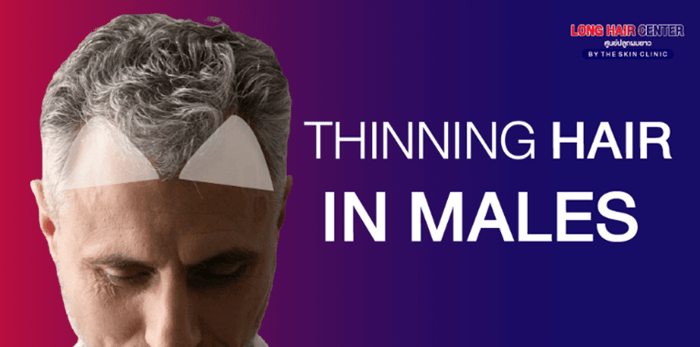
Thinning hair in males
Thinning hair in men usually occur on the mid-scalp region (on top of the head) which can be found around 2 out of 3 in men. Another area is on the frontal region or hair line on top the forehead. If hair loss occurs in both areas, the risk of baldness could increase.
Hair loss in men typically starts on frontal hair line on top of the forehead and recedes into an M shape. It is a very common pattern of thinning hair in male. Without hair loss treatment, thinning hair can progress further to the middle of the scalp which ultimately, turn into baldness and left only some of the hair behind ears and around the nape of the neck.
Thinning hair in females
- Thinning hair on the middle of the scalp : This can be noticed from the abnormal hair parting which, parted hair will become wider overtime and gradually, reveal a visible scalp. It can continue to expand from the center while the hair on the back of the scalp remains thick and perfectly normal.
- Thinning hair all over the scalp : This can be noticed by the hair strand’s appearance around the frontal (area near the forehead), the middle and the back of the scalp which is small and thin.
No matter how severe your hair loss is, it could be restored. Restoring hair loss, thinning hair to be thick again without a hair transplantation.
There is no perfect formula for hair loss and thinning hair loss treatment which can be applied for everyone. In fact, hair transplant cannot treat every case either. Patients can consult a hair transplant surgeon if they do not want to have a hair transplant to find alternative ways to treat hair loss and thinning hair problems. However, the scalp condition needs to have hair follicles. Keep in mind, the alternative treatment will be ineffective if hair follicles on the scalp are dead or patient’s scalp has entered a state of baldness. There are many ways to take maintain, restore, and nourish the hair and scalp as follows:
Growth Factor
It is a treatment that uses a patient’s own platelets to restore damaged hair follicles, deaccelerate hair loss, stimulate the hair growth but new hair follicles cannot be created.
FRM Anti Hair Loss
A thinning hair innovative treatment is used to make hair thicker without hair transplant. A device called Fractional Microneedle RF combined with Premium Growth Factor injection. Fractional Microneedle RF stimulates blood flow, increases absorption, stimulate damaged hair roots to be reactivate. The new growth hair will be stronger and bigger.
ALMI Nano Fat Transfer
A thick hair treatment without a hair transplant which stimulates and strengthens the hair follicles by injecting the patient's fat using the ALMI Nano Fat technique. It helps strengthen new hair to be healthier.
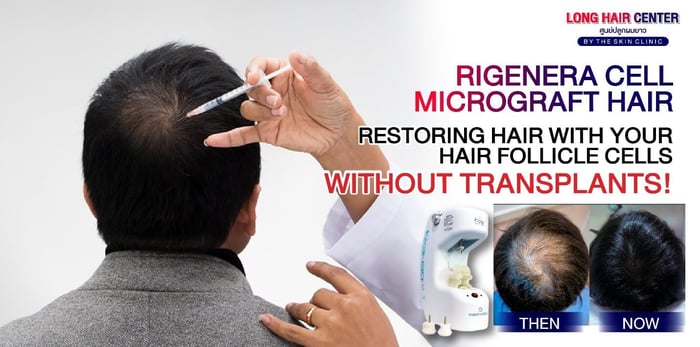
RIGENERA Micrograft Hair
Create new hair from your own hair follicles to solve the problem of severe hair loss and weak hair roots. It is an alternative option for those who are experiencing hair loss and thinning hair without getting a hair transplant. The growth factor extraction is from the patient's hair roots and then injected into the problem area of the scalp. It reduces hair loss, stimulates hair roots and makes hair thicker.

Time to say farewell to hair loss problems, restore your thick healthy hair and regain confidence with a safe and effective hair loss treatment with the premium standard clinic that provides one-stop service solutions for hair care and restoration. Our specialized and experienced medical team provides a personalized treatment plan based on your requirements to ensure a satisfactory result.
Bring back confidence once again and The Skin Clinic.
Don't wait any longer! Schedule your free consultation with our experts today!