Table of contents
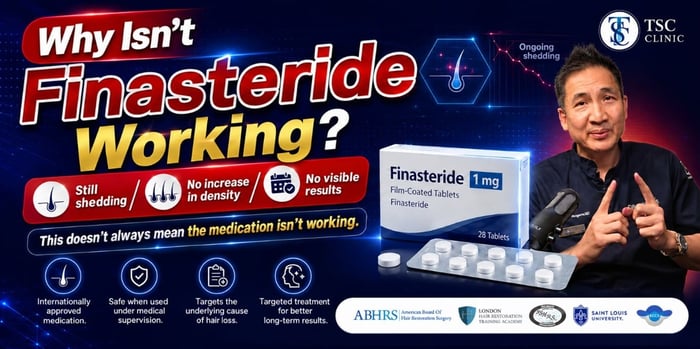
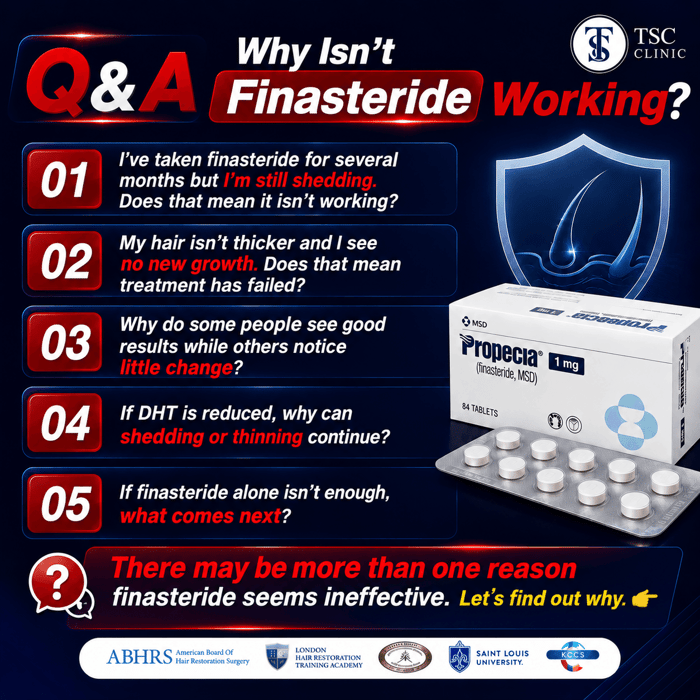
- You’ve been taking Finasteride for several months, but your hair is still falling out. Does this really mean that “the medication isn’t working”?
- You’ve been taking the medication, but your hair has not become thicker and there is no new hair growth. Does that mean it is not working, or do you simply need to give it more time?
- If DHT levels have already decreased, why can your hair still continue to thin? A deeper look at the hidden factors involved.
- Why do some people respond well to Finasteride, while others see little or no noticeable results?
- What should you do when Finasteride alone is not enough? What are the next steps?
Hair loss and thinning hair are concerns that can cause anxiety for many people. Although Finasteride is a popular medication for treating hair loss, why do many people still feel that their hair continues to fall out after taking Finasteride and does not become thicker as they had hoped? This article will take an in-depth look at the real reasons why Finasteride may not seem to be working, as well as targeted solutions that can help address the problem effectively and restore your confidence in your hair once again.
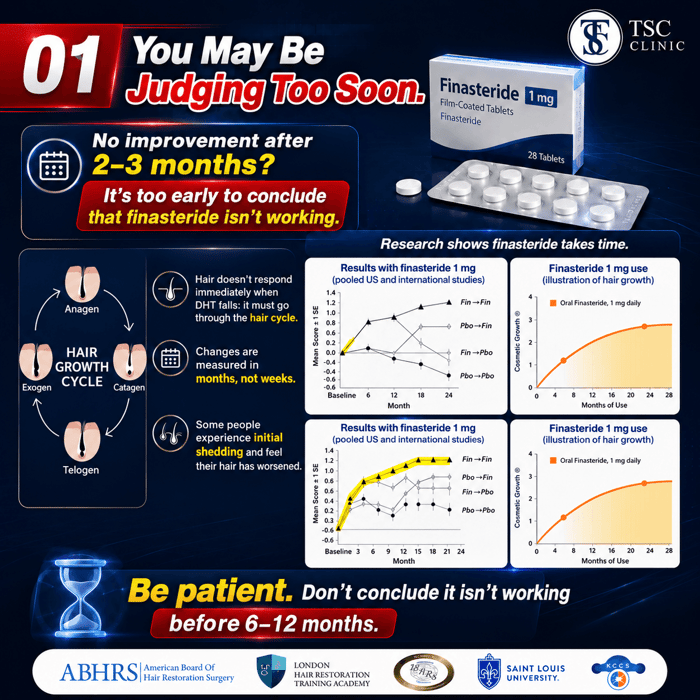
You’ve been taking Finasteride for several months, but your hair is still falling out. Does this really mean that “the medication isn’t working”?
Don’t jump to conclusions too quickly. Some people take Finasteride for only 2–3 months and see no noticeable changes, but this is still too early to conclude that Finasteride is not working. Research has shown that Finasteride generally requires at least 6–12 months of use, with continued treatment for approximately 18–24 months to achieve its maximum effectiveness. This is because hair goes through a natural Hair Cycle, so visible changes take time. Progress should therefore be evaluated on a monthly basis rather than week by week. During the early stages of treatment, some people may experience Hair Shedding, which can make it seem as though their hair condition is getting worse. With Finasteride, results usually begin to become more noticeable after 6–12 months. If the medication is discontinued, the benefits may gradually decline. Therefore, continuous use is generally necessary to maintain the results for as long as possible.
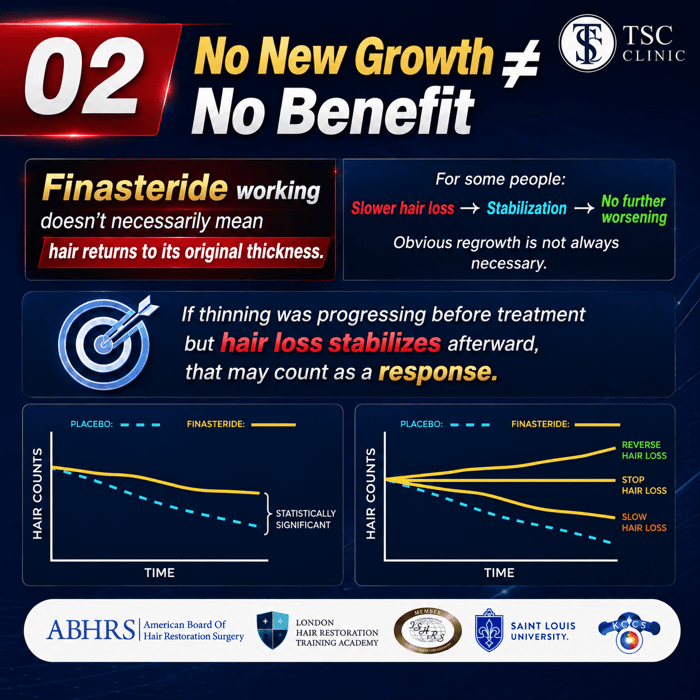
You’ve been taking the medication, but your hair has not become thicker and there is no new hair growth. Does that mean it is not working, or do you simply need to give it more time?
No new hair growth ≠ No results. Finasteride being effective does not necessarily mean that your hair will return to its previous thickness. For some people, the result may simply be that hair loss slows down, the existing condition is maintained, and the hair does not continue to worsen. Visible new hair growth does not always have to occur. If your hair had been gradually thinning before starting the medication, but after taking Finasteride you no longer experience increased hair loss or your hair density remains stable rather than continuing to decrease, this can also be considered a response to treatment.
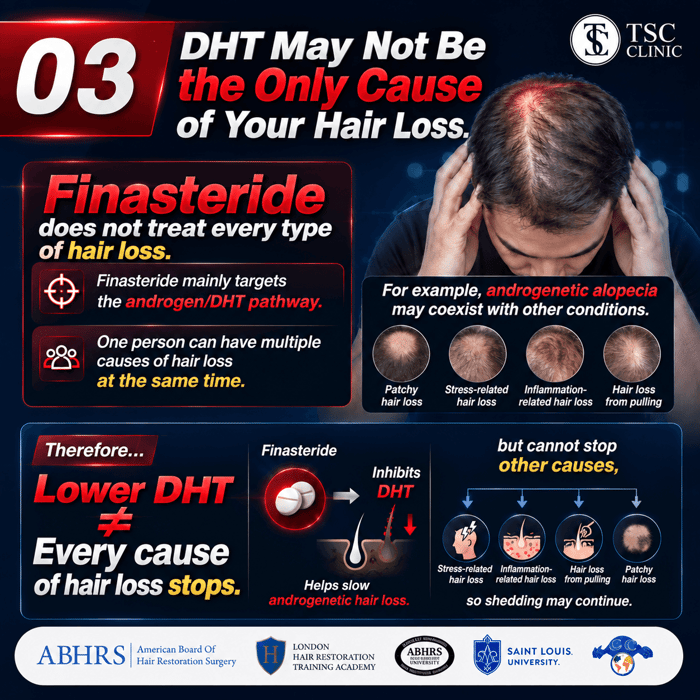
If DHT levels have already decreased, why can your hair still continue to thin? A deeper look at the hidden factors involved.
Hair thinning may not be caused by DHT alone, and Finasteride does not treat every type of hair loss. Its primary target is the androgen hormone pathway, particularly DHT (Dihydrotestosterone). A person can have more than one cause of hair loss at the same time. For example, someone may already have Androgenetic Alopecia while also experiencing hair loss caused by another condition.
Therefore, lowering DHT does not mean that every possible cause of hair loss or thinning will automatically stop. Finasteride works by inhibiting DHT, helping to slow down hereditary hair loss, but it cannot stop hair loss caused by other factors, such as stress, inflammation around the hair follicles, hair pulling, or alopecia areata. As a result, hair may continue to fall out despite reduced DHT levels. For this reason, one of the most important steps before undergoing treatment with Finasteride is identifying the true cause of hair loss. For example:
- Some people are repeatedly diagnosed with hormone-related hair loss and are treated with oral medication without seeing any improvement. However, after undergoing a detailed hair follicle and scalp examination, it may be discovered that the actual cause is a type of alopecia areata with no clearly identifiable cause. Once the treatment approach is changed accordingly, the hair may eventually begin to grow back.
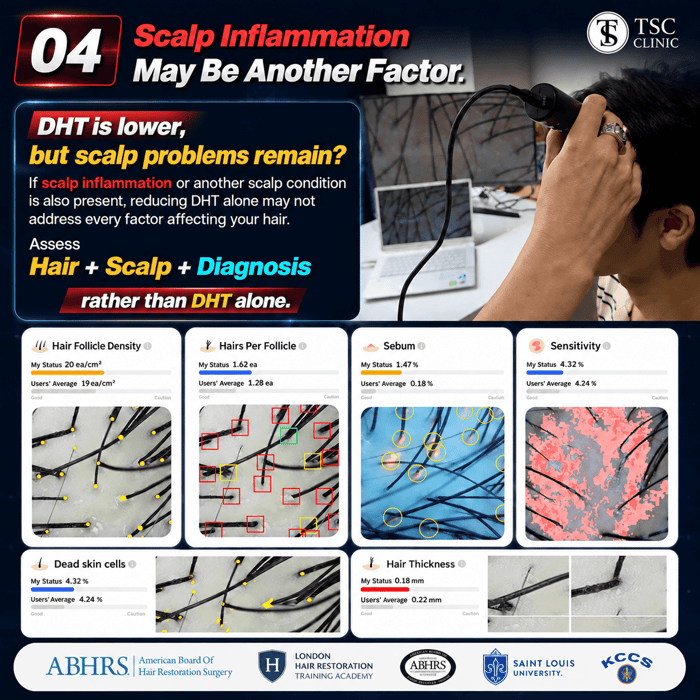
- Scalp Inflammation may also be another contributing factor to hair loss. Even if DHT levels have decreased, problems with the scalp may still remain. If there is scalp inflammation or another scalp condition present at the same time, lowering DHT alone may not address all of the factors contributing to hair loss.
Why do some people respond well to Finasteride, while others see little or no noticeable results?
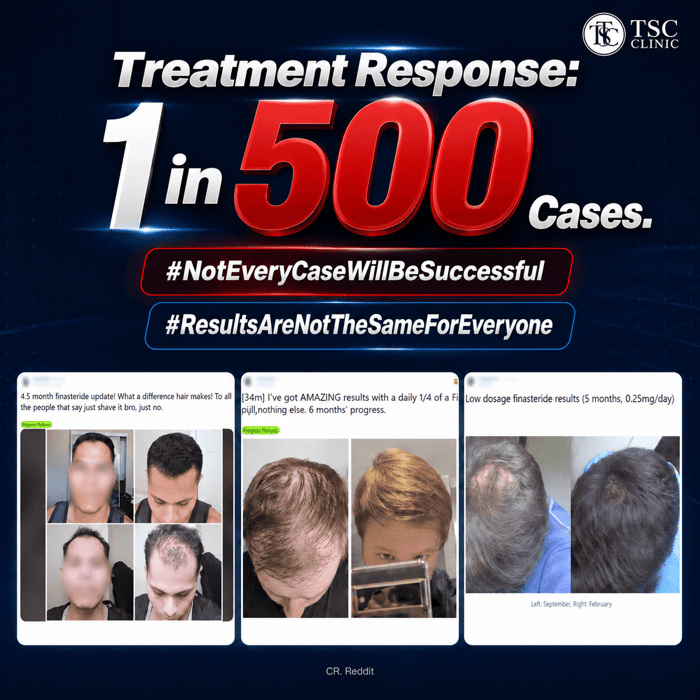
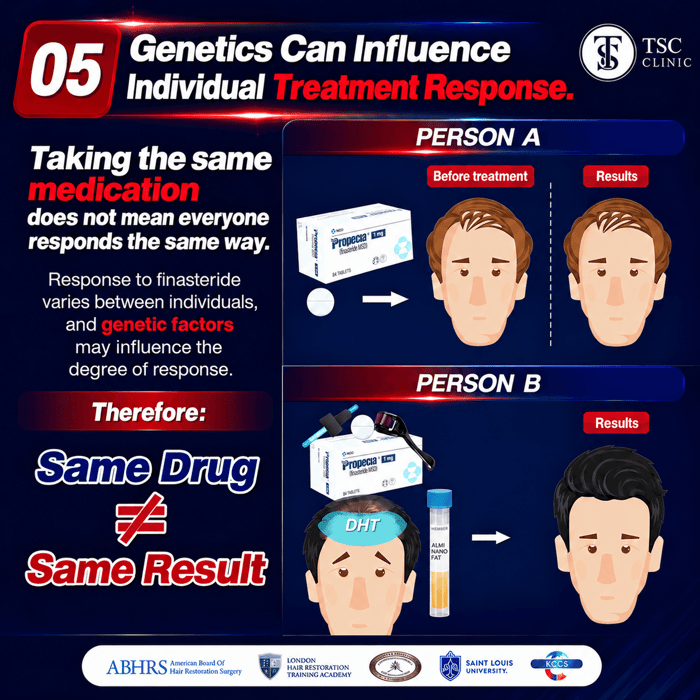
“Because genetics can cause each person to respond differently.” Taking the same hair loss medication does not mean that everyone will respond in the same way. Responses to Finasteride vary from person to person, and Genetic Factors may play a role in determining how well an individual responds to treatment. If treatment is started early, while a significant amount of hair is still present, Finasteride can help reduce the effects of DHT, slow down hair thinning, and maintain the existing hair condition for longer. However, in cases where the hair has already become severely thin, the possibility of substantial new hair growth may be limited. This is because the fundamental mechanism of Finasteride is to inhibit the production of DHT, not to create new Hair Follicles.
What should you do when Finasteride alone is not enough? What are the next steps?
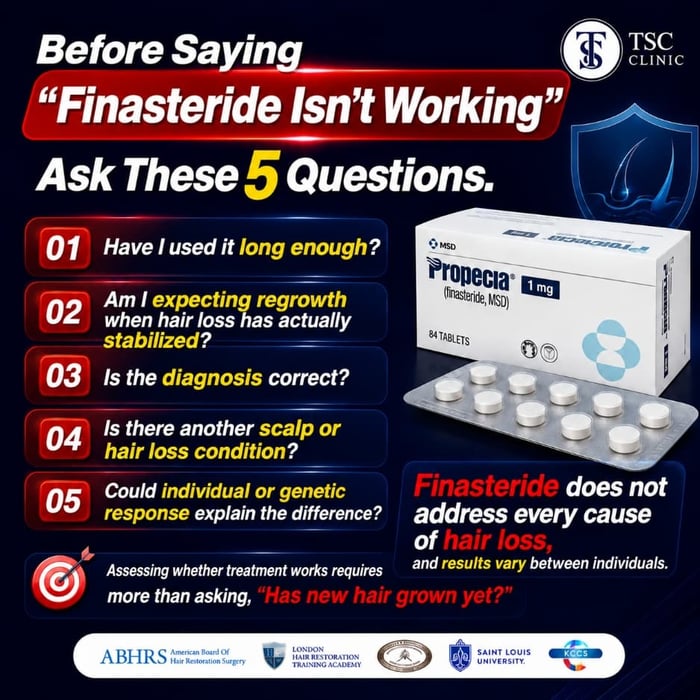
Consider these 5 points first:
- Have you been using it long enough? Do not conclude that the treatment is ineffective if you have been using it for less than 6–12 months.
- Are you expecting new hair growth even though the progression of hair loss may have already stopped or stabilized for a period of time?
- Were you correctly diagnosed from the beginning?
- Do you have scalp inflammation or other factors that may be contributing to hair loss?
- Could your response to the treatment be an individual response influenced by genetics?
When evaluating whether Finasteride is working, you should consider more than simply asking, “Has any new hair grown yet?” Most importantly, you should not stop taking the medication on your own. Instead, the underlying problem should be reassessed to determine what is actually causing the hair loss before deciding whether the treatment should be adjusted or whether additional treatment options should be introduced. There are several techniques available to help slow down hair loss and restore or stimulate the hair follicles. At THE SKIN CLINIC, we offer hair follicle stimulation using fat-based regenerative treatment that may help provide an alternative approach to oral medication, such as ALMI Nano Fat, as well as other techniques including SVF for Hair Loss and FRM Anti Hair Loss.
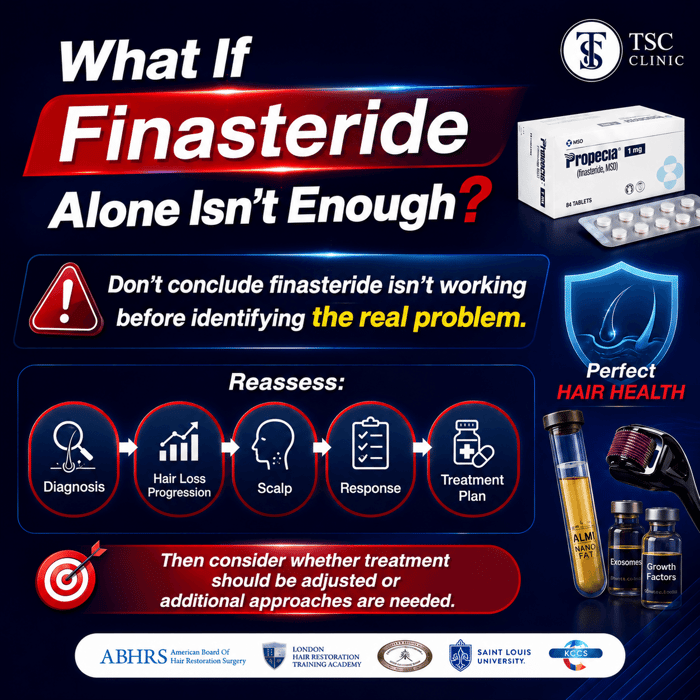
Finasteride does not treat every cause of hair loss or thinning hair, and treatment results can vary from person to person. An accurate diagnosis is the key to effective treatment because, for some people, hair loss may be caused by more than one factor. It is recommended to consult a doctor for a thorough evaluation of the hair and scalp so that the most appropriate and targeted treatment plan can be developed.