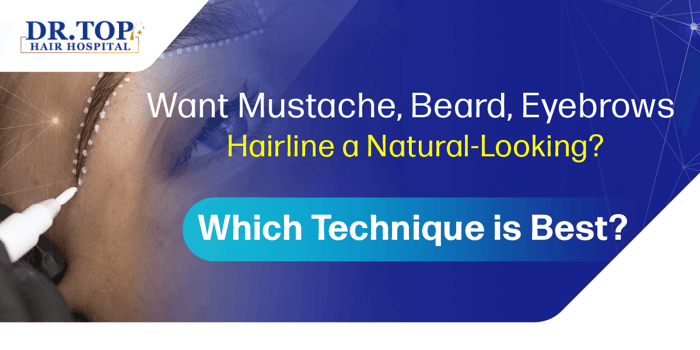
For the modern man, having a well-shaped Mustache, Beard, or sharp eyebrows not only boosts confidence but also reflects his personality and style. Many are becoming interested in facial hair and hairline transplant techniques to define their facial structure more clearly. But the key questions are how to achieve a Natural-Looking result that blends seamlessly with existing hair, and choosing Which Technique is Best to suit the individual's needs and facial structure.
Today, Beard and Mustache Transplant, Eyebrow Transplant, or hairline creation are no longer complicated. This is because Modern Medical Techniques allow newly transplanted hairs to grow in the most natural direction and density, with 3D results that make it impossible to tell from any angle that a procedure was done.
Natural-Looking: Which Technique is Best?
For anyone who wants a Natural-Looking result from a mustache, eyebrow, or hairline transplant, it is crucial to choose Which Technique is Best to meet their needs. Traditional methods that involve large incisions or transplants that don't focus on hair direction can lead to stiff and unrealistic results. Therefore, techniques that emphasize single-hair transplantation and consider facial dimensions are now preferred.
Why does facial hair transplantation need to emphasize a natural look?
A Beard and Mustache Transplant, eyebrow, or hairline transplant is different from a scalp hair transplant because the hair in each area has a specific growth direction and varying density. For example:
Eyebrows must be meticulously arranged and follow the curve of the facial structure.
Mustache and beard hairs must be planted flat against the skin and angled according to the corners of the mouth and jawline.
The hairline must have a soft edge and not be a harsh, straight line.
Therefore, a 3D or single-hair transplant technique is the key to achieving realism.
Eyebrow Transplant Technique: Creating Dimension for a Sharper Face
Eyebrows are a crucial element that gives the face definition and balance. Previously, Eyebrow Transplants often used the FUE technique, which required shaving the hair at the back of the head and transplanting short grafts to the eyebrow area. However, we have now advanced to the Long Hair FUI technique, which does not require shaving the back of the head. The extracted grafts are long hair strands that can be transplanted to the eyebrows, Mustache, Beard, or hairline. Because the hairs are long, the doctor can precisely arrange the direction, density, and shape, seeing the results immediately during the procedure. This allows for the collection of sufficiently long hair grafts that can be meticulously planted along the original eyebrow line.
Key features of a 3D Eyebrow Transplant:
Eyebrow hairs are arranged naturally, not looking stiff or straight.
Thickness and shape can be adjusted to the facial structure.
No visible scars from graft extraction at the back of the head.
The direction and density of the hair are immediately visible after the procedure.
Beard and Mustache Transplant Technique: Adding Charm and Coolness to the Face
A Mustache, Beard is a symbol of masculinity and a distinct personality. A Beard and Mustache Transplant using the FUE or Long Hair FUI technique allows the doctor to determine the growth direction of each hair so that it lies naturally against the facial skin.
Key features of the Beard and Mustache Transplant technique:
The density and shape of the beard can be designed as desired.
Long hair strands are immediately visible in the newly transplanted area.
Helps boost the confidence of men with patchy mustaches or beards.
Creating a New Hairline: Adding Softness to the Face Frame
The hairline, or "baby hair," is the hair along the forehead that helps create a softer and more natural-looking face frame. The Long Hair FUI 3D hairline transplant technique involves planting small hairs in a thin, graduated line to soften the harshness of the front hairline.
Advantages of hairline creation:
Makes the face appear more youthful.
The face frame looks softer and more natural.
Suitable for both men and women who want to soften their facial features.
Why are 3D Design and Transplant Techniques Important?
The 3D transplant technique involves planting hair by hair according to the natural direction and angle. The doctor considers three main factors:
Growth direction: Must be angled as closely as possible to the real hair.
Density: Must be balanced with the surrounding area—not too thick or too sparse.
Curvature of the hair: Especially for eyebrows and mustaches, which must curve with the face.
The result is hair that looks as if it grew there naturally from the start.
Aftercare for Long-Lasting Results
After a facial hair or hairline transplant, you should strictly follow the doctor's recommendation, such as:
Avoid touching or rubbing the transplanted area initially.
Clean the area only as instructed by the doctor.
Refrain from exercise or activities that cause excessive sweating for the first 1-2 weeks.
Attend follow-up appointments to monitor hair growth and adjust the plan if necessary.
Why Choose an American Board Certified Doctor for the Transplant?
Although modern techniques help achieve a more Natural-Looking result, the doctor's expertise is what makes the difference. A skilled specialist can design a hairline that complements the face and transplant hair by hair with high precision, making the results realistic both up close and from a distance.
Transplanting a Mustache, Beard, as well as eyebrows or a hairline, not only helps to Enhance Charm and confidence but can also permanently improve and Adjust Personality and appearance for the better. Deciding Which Technique is Best depends on your goals, the desired outcome, and the Doctor's Recommendation from an American Board certified physician. Choosing a 3D, single-hair transplant technique designed according to your facial structure will make the newly transplanted hair look so Natural-Looking that it’s almost impossible to tell you've had a procedure done.