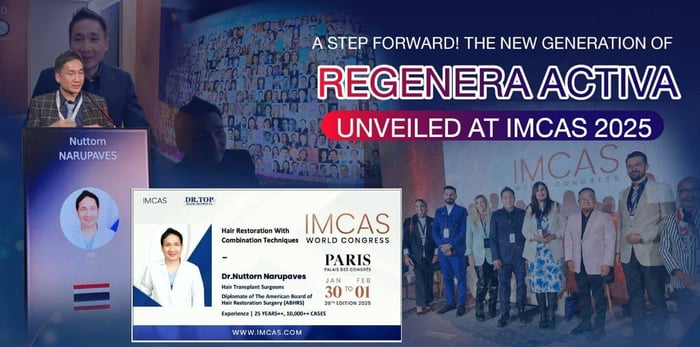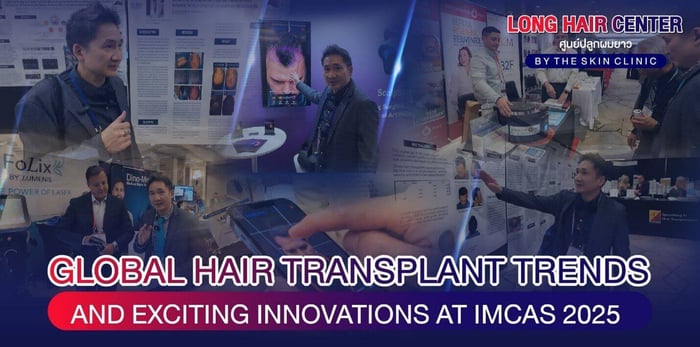
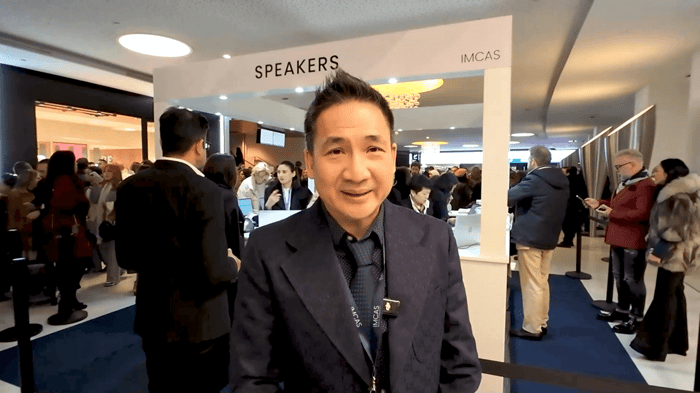
Hair transplantation continues to evolve steadily, both in terms of techniques and tools, to improve the effectiveness of treating hair loss and thinning. At The Skin Clinic, we prioritize keeping up with the latest knowledge and innovations to enhance our hair restoration services. Most recently, we participated in the IMCAS 2025 World Congress, a global platform for exchanging knowledge and updating trends in aesthetics, dermatology, plastic surgery, and anti-aging medicine. What are the exciting hair transplant innovations this year?
Table of Contents
- Get to Know the IMCAS World Congress
- Global Hair Transplant Trends and Innovations to Watch at IMCAS 2025
Get to Know the IMCAS World Congress
Global Hair Transplant Trends and Innovations to Watch at IMCAS 2025

• Trichoscopy: A tool for assessing treatment outcomes for hair loss and thinning hair
In the treatment of hair loss and thinning, whether through PRP, laser therapy, or any other method, results cannot be accurately evaluated without a clear and standardized assessment tool. So, how can treatment outcomes be measured effectively? To enable physicians to assess the condition of the hair and scalp, identify the root causes of hair loss, and tailor treatment plans to each patient, a diagnostic technology called Trichoscopy is used. This tool allows for in-depth analysis and assessment of hair quality at every stage of the treatment process. It enables systematic comparison of hair condition before treatment, during each session, and after the course is completed. Moreover, Artificial Intelligence (AI) is now being integrated to enhance evaluation accuracy. AI assists in generating detailed reports on various parameters such as hair density and distribution, allowing for faster and more precise data analysis.
• Artificial hair transplantation to support the treatment of baldness
One of the key factors to consider before undergoing a hair transplant is the number of hair follicles available in the donor area, typically the back of the scalp, which serves as the source of grafts. If this area does not have a sufficient amount of hair, a traditional hair transplant cannot be performed. To address this limitation, Artificial Hair Transplantation (also known as Biofibre implantation) has been continuously developed as an alternative for patients with inadequate donor hair. At the recent IMCAS congress, a new generation of artificial hair was introduced, featuring enhanced biocompatibility, meaning it is more biologically compatible with natural hair. This advancement helps reduce the risk of allergic reactions compared to earlier versions of synthetic hair.
• Treating hair loss and thinning hair with micrografting
The Autologous Micrografting Technique involves using the patient's own hair follicle cells to treat hair loss and thinning. A small strip of tissue is extracted from the back of the scalp, where the hair is typically strongest. This tissue is then processed using the Regenera Activa system to isolate stem cells. The high-quality cells obtained from this process are then injected into the areas of concern to rejuvenate weakened hair follicles and promote thicker, healthier hair growth.
• PRF (Platelet-Rich Fibrin) technique
The PRF (Platelet-Rich Fibrin) technique is a process in which the patient’s blood is spun at a specific speed to isolate a component called fibrin, which is rich in concentrated platelets, white blood cells, and stem cells. This fibrin is then injected back into the scalp to repair weakened hair follicles, strengthen them, and stimulate new hair growth. At the recent IMCAS 2025 congress, there was discussion about combining PRF with PRP (Platelet-Rich Plasma) to further enhance the effectiveness of hair restoration treatments.

Participation in the global congress IMCAS 2025 reflects The Skin Clinic’s strong commitment to continuous learning and advancement in hair restoration treatments. The clinic aims to apply newly acquired knowledge and cutting-edge innovations to enhance the quality of care and provide more personalized solutions for hair loss concerns. This marks a significant step forward, not only offering renewed hope to those struggling with hair thinning and baldness, but also driving the clinic’s medical team to constantly improve their expertise in order to deliver the best possible results for every patient.