Table of contents
- If hair loss is genetic and I’m thinning at the sides, front, and top, should I get a hair transplant right away?
- Why do some people take hair-loss medication but still see no improvement, with hair continuing to fall out?
- Why does hair keep shedding after taking hair-loss medication, while body hair becomes noticeably thicker?
- If don’t want to take medication, what evidence-based treatment options are available that deliver proven results?
- Case Study: A 22-year-old male patient with genetic hair loss
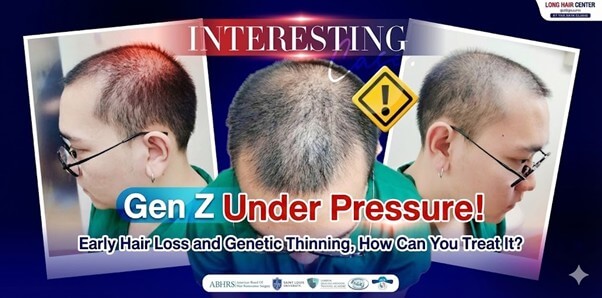
Experiencing hair loss at a young age and having genetically thin hair are becoming major problems that many people overlook. Stress, late nights, hormonal changes, and genetics all play a role in triggering premature hair loss, causing hair to become thinner and the scalp to become more visible. This can affect confidence as early as the school years or the start of one’s career. If left untreated, the condition may worsen to the point where a hair transplant becomes necessary.
This article explores the real causes of hair loss among Gen Z, along with restoration methods that don’t require a transplant, such as advanced medical technologies that stimulate hair follicles. It also covers options for those who are already experiencing significant thinning, helping slow hair loss before it becomes too late to reverse.
If hair loss is genetic and I’m thinning at the sides, front, and top, should I get a hair transplant right away?
If you are between 20–25 years old and notice signs of genetic hair loss, Dr. Top generally does not recommend undergoing a hair transplant yet, as the age is still quite young. A transplant works by relocating hair follicles from the back of the scalp to thinning areas. Once follicles are removed from the donor site, they will not grow back, so it is better to save grafts for when they are truly needed. At this age, a thorough assessment and a treatment plan that aims to slow down hair shedding should be the first priority.
Why do some people take hair-loss medication but still see no improvement, with hair continuing to fall out?
Hair-loss medication usually requires 3–6 months before noticeable improvement, and must be used consistently. However, some people continue to shed hair because hair loss can be caused by multiple factors, including severity, underlying conditions, and individual biological response. Common medications such as Finasteride and Minoxidil do not work equally well for everyone. Some patients need a longer duration, while others may require a combination of treatments to see improvements.
Why does hair keep shedding after taking hair-loss medication, while body hair becomes noticeably thicker?
With medications like Minoxidil, increased shedding during the first 2–3 months is common. But if shedding persists for 4–6 months or becomes excessive, medical evaluation is recommended. Another common side effect is increased body hair, such as facial, arm, leg, or chest hair, which can reduce confidence and may cause some people to stop using the medication.
If don’t want to take medication, what evidence-based treatment options are available that deliver proven results?
ALMI Nano Fat is a technique that helps stimulate hair follicles and strengthen the scalp using one’s own fat. It is an option for those who do not want to take long-term medication or are concerned about side effects from hair-loss drugs. Results can be seen from the first session, and there is no need to worry about allergic reactions since the patient’s own fat is used. This technique is supported by research showing that it helps increase the layer of subcutaneous fat on the scalp, improves blood flow to the hair follicles, slows hair shedding, and stimulates new hair growth.
Case Study: A 22-year-old male patient with genetic hair loss

A 22-year-old male patient with genetic hair loss experienced thinning in multiple areas at the same time. His hairline receded deeply into an M-shape, he had thinning at the crown, and patchy hair loss scattered across the scalp. Although he had previously taken hair-loss medication, the shedding continued while body hair became noticeably thicker, so he no longer wished to continue the medication. How should this case be treated?
Before starting treatment, the first step is to identify the true cause of the hair loss, whether it is vitamin deficiency, chronic stress, staying up late, or insufficient rest. This is especially important in cases of genetic hair loss, which is often more difficult to treat than other causes. In male-pattern genetic hair loss, the condition is driven by genetics and androgen hormones, particularly DHT (Dihydrotestosterone), which causes hair follicles to produce thinner, shorter, and finer hairs over time, eventually leading to thinning or baldness. Symptoms typically begin with the frontal hairline receding into an M or U shape, along with thinning at the crown. Although genetic hair loss cannot be completely cured, it can be slowed and improved with proper treatment.
In this case, the patient had already taken medication and did not wish to undergo a hair transplant, and Dr. Top assessed that a transplant was not yet necessary. Therefore, the treatment plan focused on restoring and nourishing the hair follicles across the entire scalp using the ALMI Nano Fat technique to strengthen existing hair, increase density, and slow genetic hair shedding. After undergoing ALMI Nano Fat, noticeable improvements were observed: new hair grew in previously thin areas, the existing hair became thicker and stronger, and shedding was reduced. However, the patient is still in the recovery phase, and further improvement is expected in the following stages.

Although there are many methods to treat hair loss and thinning hair, the results vary depending on the cause, hair condition, and scalp condition of each individual. If you are experiencing these problems, an accurate diagnosis is the most important first step to finding the most suitable treatment plan. You can consult a doctor at THE SKIN CLINIC to evaluate the cause of your hair loss or thinning hair and to create a targeted treatment plan that best suits the condition of your hair.