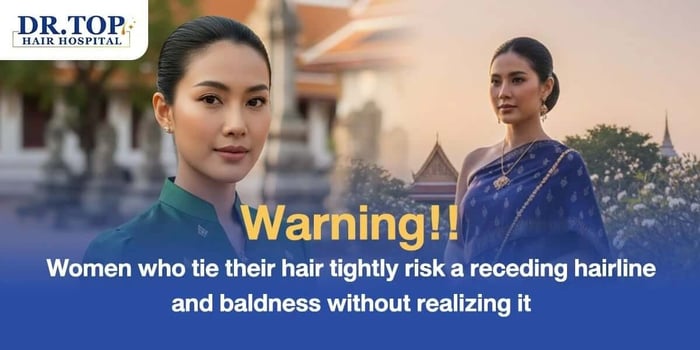
The pulling force caused by repeated tight ponytails every day can make the hair weak, fall out easily, and the hairline gradually recede without notice. Many people start to notice that their forehead looks wider, which turns into a receding hairline that causes a loss of confidence. If left untreated, it can eventually progress to baldness, which is difficult to correct.
This is a silent danger that women with tight ponytails are facing without realizing it. Because having a tight ponytail regularly, even just a little, can accumulate and cause permanent hair loss. So why exactly does this behavior become a major cause of receding hairlines and baldness? And what methods can help prevent or restore hair? You will find all the answers in this article.
Why does tying hair tightly increase the risk of a receding hairline and baldness?
Many people may think that a tight ponytail only causes a little tension or headache. But in reality, the repeated pulling mechanism can directly damage the hair roots and scalp. When the hair is tied tightly for a long time, the pressure and pulling force reach the hair follicles, reducing blood circulation in the area. Hair roots lack nutrients and sufficient oxygen. The result is weak hair that falls out more easily than usual.
In medical terms, this condition is called Traction Alopecia or “hair loss from pulling,” which is a problem commonly found in women who regularly tie their hair tightly. Whether it is a high ponytail, tight braids, or even wigs and hair extensions with too much pulling force. Although it is not a serious disease, if not treated in time, it can lead to long-term damage.
Short-term effects: Tight scalp, discomfort when touching, often accompanied by headaches. Hair around the temples and forehead falls out easily, and hair breaks in the middle because of excessive pulling force.
Long-term effects: When the hair roots are repeatedly damaged, the hairline gradually recedes, becoming a receding hairline clearly. And if left untreated until the roots are permanently destroyed, it may progress to baldness, which cannot regrow naturally.
Therefore, even though tying hair tightly may seem like a small matter in daily life, in fact, it is one of the main causes that make many women face hair loss and baldness without realizing it.
Warning signs that you are facing this problem
Hair loss problems in women from tight ponytails do not happen immediately, but gradually accumulate until symptoms appear little by little. If not noticed in time, the problem may progress to a receding hairline or even baldness. Therefore, recognizing the warning signs from the early stage is important.
Tying hair and feeling headaches or scalp tension
If every time you tie your hair and feel pain or tension in the scalp, it means there is too much pulling force. This is one of the first warning signs that should not be ignored, as it is the starting point of damage to the hair roots.
Hair around the temples and forehead falls out abnormally
These areas are often pulled the tightest when tying hair, making them the most vulnerable to hair breakage. If you notice that the hair at the temples starts thinning more than usual, this is a clear warning sign.
Hairline receding until the forehead becomes wider
A forehead that looks increasingly exposed is often caused by the weakening and falling of hair in the frontal line. This is the beginning of a receding hairline that many people may not be aware of.
Patchy hair loss, even without chemical treatment
If you have not dyed, permed, or straightened your hair, but still notice patchy hair loss, especially in the front hairline and temples, it shows that the scalp may already be facing Traction Alopecia.
If you find any of these symptoms, you should immediately change your habit of tying your hair tightly before the hair damage becomes severe and more difficult to treat.
How to prevent hair loss from tight ponytails
Even though tight ponytails are a hairstyle that many people feel confident with, if done too often, it can cause the hairline to recede and lead to a receding hairline, or even worse, baldness. Therefore, making small adjustments in habits can help prevent and reduce the risk of a receding hairline, baldness, and hair loss from pulling (Traction Alopecia).
Change the way you tie, reduce the tightness
It is not necessary to tie your hair tightly every time. Tying loosely or changing the tying position, such as tying it high or low, will help distribute the pulling force and avoid straining the same spot repeatedly.
Use gentle accessories
Avoid using small, hard hair ties or plastic bands that pull strongly. Instead, choose fabric bands, silicone ties, or clips that do not grip too tightly to reduce the chance of breakage.
Let your hair rest
Letting your hair down allows the scalp and hair roots to breathe without being pulled all the time. Especially on days at home or while sleeping, you should avoid tight ponytails.
Nourish the scalp and hair
Use hair oils, serums, or sprays that strengthen the roots and reduce hair fall. Gentle massages also help stimulate blood circulation, allowing the roots to receive enough nutrients.
Avoid hair extensions or wigs that pull
Although they can change your look, extensions or wigs that pull heavily can make hair fall faster. If necessary, choose methods that do not harm the hair roots too much.
What should you do if you start having a receding hairline or baldness?
If you start to notice or feel that you are beginning to have baldness, with the hairline starting to recede and showing clear signs of a receding hairline, adjusting behavior alone may no longer be enough. The important thing is to seek consultation from experienced doctors to assess the severity and find the right treatment for each individual. However, it is crucial to choose a hair transplant clinic that meets standards, especially our team at The Skin Clinic (TSC), which has American Board (ABHRS) certified doctors who can analyze and plan treatment systematically and safely for patients.
Popular treatment approaches include:
Shaven FUI Hair Transplant
A standard method widely used around the world, where doctors transplant hair roots one graft at a time from the back of the head to the thinning or receding area. The advantage is that it can be performed in large quantities, suitable for those with wide thinning areas and who need a large number of grafts. Although partial shaving is required for convenience, the benefit is quick recovery and clear regrowth results.Long Hair FUI Hair Transplant
The highlight is that it does not require shaving the entire head, allowing patients to continue their daily lives immediately. It is suitable for those who do not want others to notice during recovery, and it allows immediate visibility of the new hairline after the procedure. It is ideal for both women and men concerned about appearance.Hair Transplan tDHI (Direct Hair Implantation)
A modern technique that uses specialized tools to implant hair directly after graft extraction, reducing the chance of graft deterioration and increasing growth rates. The results are natural-looking and dense, perfect for those who want detailed hairline design closest to the original.Women’s Long Hair Hair Transplant
A specialized technique designed specifically for women, focusing on natural results without the need for long recovery. It boosts confidence immediately after the procedure, suitable for women with thinning hair, receding hairlines, or receding hairline problems, without affecting daily appearance.
These techniques are effective and suitable for both women and men who want to seriously address hair loss, baldness, or receding hairlines. The choice of technique depends on each person’s hair condition. If you are not sure which method is right, you can visit the experienced medical team at The Skin Clinic (TSC). We are ready to take care of you with full service.
Summary: The silent danger of women who like to tie their hair tightly
Tying hair tightly may seem like a small matter, but in reality, it is a silent danger that causes many women to experience hair loss, receding hairlines, or baldness. Tying hair too tightly creates pulling that can lead to Traction Alopecia with out realizing it. If you start noticing signs such as a receding hairline, thinning hair, or scalp tension, you should immediately change your habits by loosening hairstyles, letting hair rest, and taking care of the scalp to keep it strong.
But if the problem has already progressed clearly, consulting experienced professionals is the key solution. Especially at The Skin Clinic (TSC), where our clinic has American Board (ABHRS) certified doctors specializing in hair transplantation, with experience in more than 10,000 cases. We provide modern hair transplant techniques for both women and men, such as Long Hair FUI, which allows quick recovery and delivers natural results. You can be confident in both the safety and beauty of your new hairline.