Table of contents
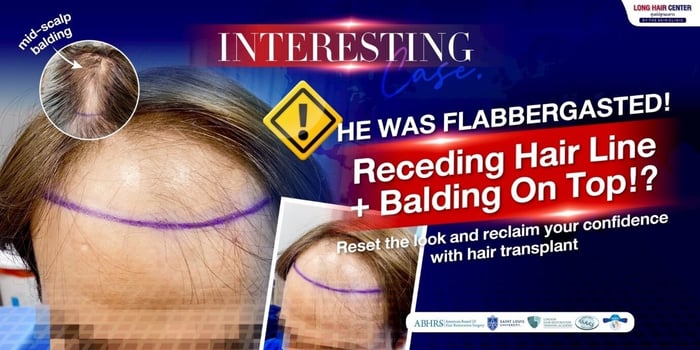
The problem of baldness, thinning hair on the top of the head over a wide area, is something that makes many people lose confidence and see regaining thick hair again as impossible. But not for this case! We will take you to dive deep into the hair transplant case of a German patient who faced such problems and underwent a hair transplant with Dr. Top at THE SKIN CLINIC, until he was able to regain naturally thick hair, transforming his appearance to look good again in an amazing way.
STORYTELLING INTERESTING
In this case, what is the best way to treat hair problems?
- With a high hairline and thinning hair, should I go for a hair transplant right away?
- If the hairline has receded almost to baldness, can “medication” really make the hair grow back?
- Is it truly possible to transplant hair in areas of the scalp that are shiny and bald?
- Does using a large number of grafts in a hair transplant affect the results?
Hair Transplant Review for a German Patient
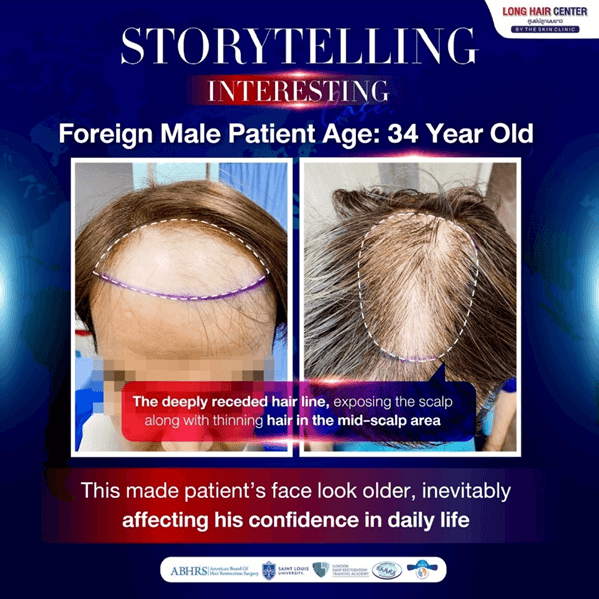
This is a case of a 30-year-old male patient with thinning hair and baldness in the frontal area. The first factor to consider when determining whether hair transplantation is possible is the hair at the back of the head, known as the Donor Area, which is the source of grafts for transplantation. In this case, the patient had strong and dense hair in the Donor Area, making it possible to transplant hair follicles. For the frontal scalp area with no hair, it was not only about implanting new grafts but also about maintaining and protecting the existing surrounding hair as well.
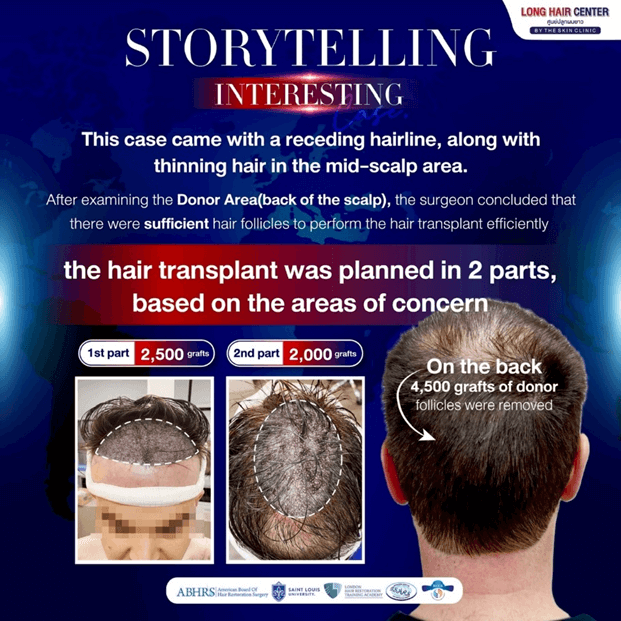
Another challenge in this case was that the hair on the top of the head had also begun thinning. So why didn’t the doctor decide to transplant more hair there? Because a hair transplant means relocating follicular units from the Donor Area, which is limited in supply. Once extracted, no new hair grows back in the donor site. Since the patient was still young, the doctor decided to reserve some grafts for future use. If all were used at once, there would be no grafts left for additional transplants later. Instead, the doctor recommended an alternative treatment: the ALMI Nano Fat technique, which uses the patient’s own fat injected into the scalp to stimulate hair follicles, improve blood circulation, thicken miniaturized hair, and strengthen it without the need for more grafts. This technique also slows down hair loss and protects hair follicles from DHT (Dihydrotestosterone), the main cause of hereditary male pattern baldness. Combining hair transplantation with fat injections helps reduce shock loss after the procedure and increases graft survival rates.
What is the Long Hair FUI Hair Transplant Technique?
The Long Hair FUI (Follicular Unit Implantation) technique allows transplantation without shaving the back of the head. This means no visible scars, and the density and direction of the transplanted hair can be seen immediately after the procedure. The technique uses a precise tool called the Implanter Pen, which minimizes follicle injury and maximizes graft survival rates. The steps of Long Hair FUI are as follows:
- Needle-free anesthesia injection: A special technique used at THE SKIN CLINIC, where air pressure is used instead of needles to deliver anesthesia to the target area.
- Long hair graft extraction: Hair grafts are extracted from the back of the head using specialized tools.
- Selection of quality grafts: Only complete grafts with intact follicles and tissue covering are chosen.
- Implanting the grafts: Using the Implanter Pen to carefully and precisely place grafts into the desired areas.
Why is taking care of the existing hair just as important as a hair transplant?
The success of a hair transplant depends on three factors: the number of grafts used, the doctor’s expertise, and aftercare. Crucially, patients must maintain their existing hair (Existing Hair) for as long as possible. Hair loss is complex and influenced by many factors, especially hereditary baldness. A transplant does not solve all problems, because genetic influences remain, and non-transplanted hair may continue to thin and fall out over time. For patients with hereditary hair loss, doctors usually recommend continuing oral medication after transplantation to preserve existing hair. However, for patients who do not want to take medication, other options are available to slow hair loss, such as SVF for Hair Loss, ALMI Nano Fat, FRM Anti Hair-Loss, and Regenera Micrograft Hair.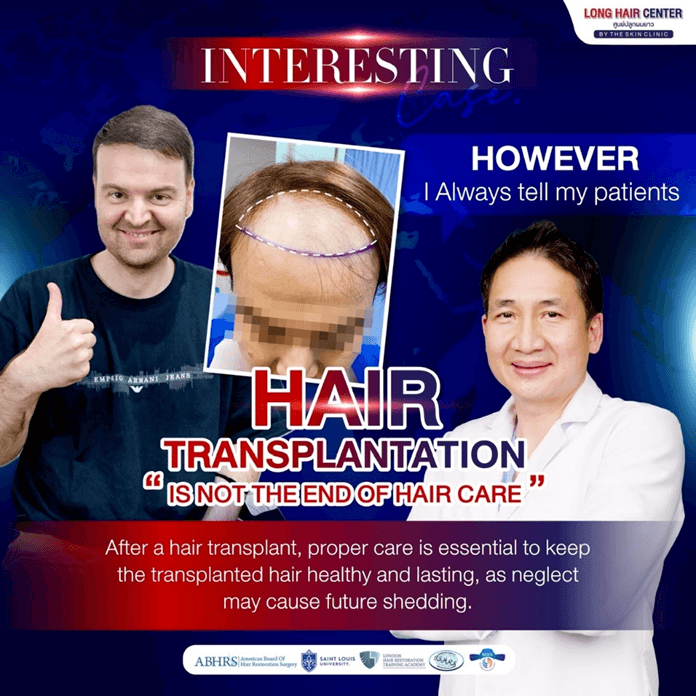
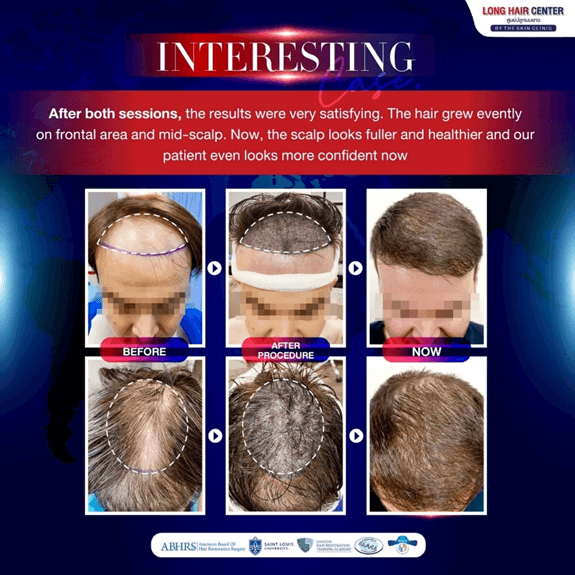
The results of this hair transplant case show that the problem of baldness, which once seemed hopeless, can in fact be solved. The hair has grown back thick and natural, and the facial frame looks noticeably better.
It transforms the feeling of “impossible” into “possible” through hair transplantation performed by the skilled medical team
at THE SKIN CLINIC.
If you are someone struggling with thinning hair or baldness, don’t let your worries undermine your confidence. Come and consult with our specialists at THE SKIN CLINIC. We are ready to provide guidance and find the most suitable treatment plan just for you.