Table of contents
- Hair Transplants to Solve the Problem of a Wide Forehead or Unclear Facial Frame
- Why Do Some People Have a Wide Forehead? What Factors Cause the Hairline to Recede?
- What is a Forehead Hair Transplant? How is it Different from a General Hair Transplant?
- Hairline Design Suitable for the Face: Female vs. Male
- Hair Transplant Techniques Suitable for Solving the Wide Forehead Problem
- Advantages of Facial Frame Hair Transplant
- Conclusion: Is it Possible to Have a Wide Forehead Hair Transplant to Define the Facial Frame?
"Is my forehead too wide?" is a question many people ask themselves every time they look in the mirror, especially as they get older or start noticing their hairline receding. Whether it's women who want to add softness to their face or men who want a more defined, sharp facial structure, wide forehead hair transplants have become an interesting option for correcting the wide forehead and Unclear facial frame to a more desirable shape, particularly for those with a wide forehead or an unclear facial frame.
Many people may still be unsure if "hair transplant can really solve the problem of a wide forehead?" The answer is yes, but whether the results are good depends on a detailed assessment, designing a hairline that suits the facial structure, and a technique appropriate for each individual. Whether it's a case of a male hair transplant that emphasizes a strong, sharp look or a female forehead hair transplant that focuses on softness and gentleness, planning with a doctor is key to creating a natural-looking result that truly meets their needs.
Hair Transplants to Solve the Problem of a Wide Forehead or Unclear Facial Frame
Many people with a wide forehead or unclear facial frame often think it's just a "personal characteristic" they have to accept due to genetics or age. But in reality, this problem can be changed with a facial frame hair transplant, a technique that designs a new hairline suitable for each person's face. It helps reduce the size of the forehead, enhances the facial structure to be more proportional, and boosts confidence without needing makeup or hairstyles to cover it up anymore.
A hair transplant to adjust the hairline and facial frame is not just about filling in thin or receding areas. It requires an understanding of facial structure, the Golden Ratio, and setting the direction of the hair to blend in with the original hair. This technique therefore requires a team of highly experienced doctors who understand artistic design, just like a facial surgery that doesn't require a scalpel.
Hair transplants on the forehead and facial frame can be done for both women and men, with differences in the design details, such as:
Male Hair Transplant: Often emphasizes a sharp hairline and square corners to enhance a cool, strong personality.
Female Forehead Hair Transplant: Focuses on the curves of the hairline and fine baby hairs to make the face look softer and more balanced.
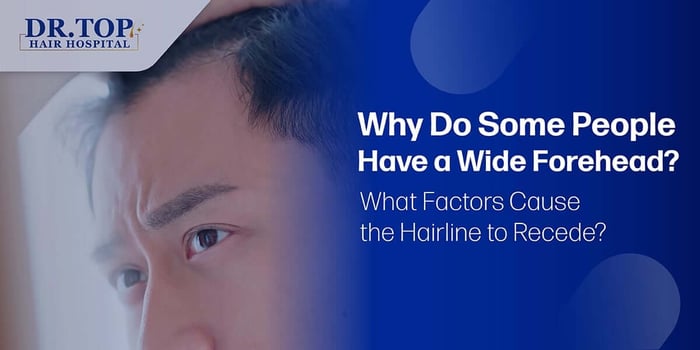
Why Do Some People Have a Wide Forehead? What Factors Cause the Hairline to Recede?
A wide forehead can be caused by several factors, including genetics, hereditary traits, or daily habits that affect hairline recession, which can occur in both men and women.
Common factors include:
Genetics: If people in the family have a tendency for a receding hairline or a wide forehead, there is a high chance that the next generation will inherit the same trait.
Male Hormone (DHT): Affects the hair cycle, causing hair roots to weaken faster and the hairline to recede, especially in the temporal areas and the middle of the forehead.
Stress: Affects hormones and blood circulation to the hair roots, causing hair to thin and fall out faster than usual.
Tight hairstyles, frequent chemical treatments, or long-term hat wearing can also weaken hair roots and push the hairline backward.
A receding or thinning hairline can make the forehead look wider than it is. Although it's not a direct health problem, it significantly affects many people's appearance and confidence.
What is a Forehead Hair Transplant? How is it Different from a General Hair Transplant?
A forehead or frontal hairline restoration is the process of moving hair roots from a strong area, such as the back of the head, to the forehead to create a new, natural-looking hairline and help define the facial frame.
Key differences from a general hair transplant:
Uses fewer grafts: A frontal hairline transplant uses fewer grafts than a full-area hair transplant.
Emphasizes design: Requires detailed analysis of the face, forehead shape, and hairline placement.
Requires high precision: Because the frontal hairline is the most visible area, it must be transplanted to blend in with the original hair.
Importantly, a forehead hairline transplant doesn't just make the "hair look thick"; it's a way to adjust the overall personality, such as making the face look more dimensional, balanced, and reducing the feeling of a "high forehead" or "wide forehead" effectively.
Hairline Design Suitable for the Face: Female vs. Male
A forehead hair transplant requires "hairline design" based on each person's face shape. This is because it's not just about filling in hair but about filling it in a way that "blends in" and "enhances the personality" as much as possible.
For Men
The hairline is often an "M-shape" or "square straight" (masculine hairline).
The starting hairline is slightly higher than for women.
Must maintain left-right symmetry and sharpness at the temporal angles.
For Women
The hairline is often curved and has soft baby hairs on the forehead.
The hair starts slightly lower to make the face look softer.
The baby hairs on the sides help make the face look smaller, especially for women with a wide forehead but a small face shape.
The doctor will design the hairline based on the Golden Ratio, forehead height, head curvature, and original hair characteristics to ensure the results are as natural as possible.
Hair Transplant Techniques Suitable for Solving the Wide Forehead Problem
The choice of hair transplant technique greatly affects the naturalness of the hairline and confidence after the treatment, especially for transplants on the frontal hairline and facial frame, which are the most visible areas.
Suitable techniques include:
Long Hair FUI
This technique allows for hair transplantation without any shaving, even in the donor area. This means you can get an immediate, visible new hairline. It's an excellent option for women who want to restore their hairline to look more youthful without changing their hairstyle. It’s also popular among men who want a hair transplant without others noticing the treatment. This technique is favored by celebrities, professionals who need to maintain their appearance, and those who can't take a long time off to recover.
Advantages:
No shaving is required, not even in the donor area.
You see immediate results because the transplanted hair is long.
Ideal for women, as there's no need to wait for the hair in the back to grow before the transplant.
Short Hair / FUE Hair Transplant
This technique involves harvesting grafts from the back of the head. Typically, a portion of the hair must be shaved to clearly see the grafts. It's suitable for men or anyone who isn't concerned about their hairstyle during the recovery period. The key advantage is that a large number of grafts can be transplanted in a single session, making it ideal for cases with a large transplant area, such as the crown or mid-scalp.
Advantages:
Can cover a large area.
More affordable than the Long Hair FUI technique.
Requires less time for harvesting and transplanting grafts.
Limitations:
The donor area must be shaved.
Not suitable for people who want to keep their original look after the procedure.
Combination Transplant with ALMI Nano Fat
This is a specialized technique that enhances the effectiveness of a hair transplant. It involves injecting the patient’s own fat, which is rich in Growth Factors, to stimulate the hair roots before and after the transplant. This helps strengthen the grafts, reduce inflammation, and increase their survival rate. It's perfect for cases that require clear, permanent results and a denser-looking hairline.
Who it's for:
Individuals with weak hair roots due to chronic hair thinning.
Those who want a more defined facial frame.
People who want to enhance the results of their hair transplant for a denser and longer-lasting outcome.
Advantages of Facial Frame Hair Transplant
A hair transplant to adjust the facial frame is not only beneficial for aesthetics but also has a positive impact in many areas, such as:
Facial Balance: Helps reduce the feeling of a forehead that is too wide or a face shape that is too long.
Increased Confidence: Many patients feel more confident and don't have to cover their forehead or worry when tying their hair up.
No need for heavy makeup/hairstyles to hide the forehead: Especially for women who used to have to use hairstyles to cover their forehead.
Permanent results: The transplanted hair will stay with you for life when cared for according to instructions.
Immediate return to daily life: If you choose a no-shave hair transplant technique, such as Long Hair FUE.
Things to Know Before Deciding on a Wide Forehead Hair Transplant
You should consult a doctor with extensive experience in hairline design, as hair transplantation along the facial frame is an art, not just a technique.
You don't have to wait until all your hair has fallen out to get a hair transplant. The sooner you plan, the more you can preserve your original hairline.
A frontal hairline transplant is not just for men; women with thin baby hairs or an unclear hairline can also have it done.
The results are gradual. New hair will start to grow in 4-6 months, and the full results will be visible in about 9-12 months.
Take good care of your scalp after the transplant, such as avoiding strong contact or sleeping on the transplanted area.
Conclusion: Is it Possible to Have a Wide Forehead Hair Transplant to Define the Facial Frame?
The answer is "yes, it is possible" and the results are clear if planned correctly. Whether it's choosing the right hair transplant technique, designing a hairline that suits your face, or proper aftercare, all factors have an impact on the long-term results.
A Hair transplant for facial frame adjustment is not just about beauty. It's about increasing confidence, enhancing personality, and changing your appearance to look younger and more vibrant again. Whether you are a woman with a wide forehead from genetics or a man with a receding hairline due to hormones, these problems can be genuinely solved with safe and effective medical procedures.